
Catholic Therapy Center

Not Too Late – Embracing the Jubilee Year of Hope
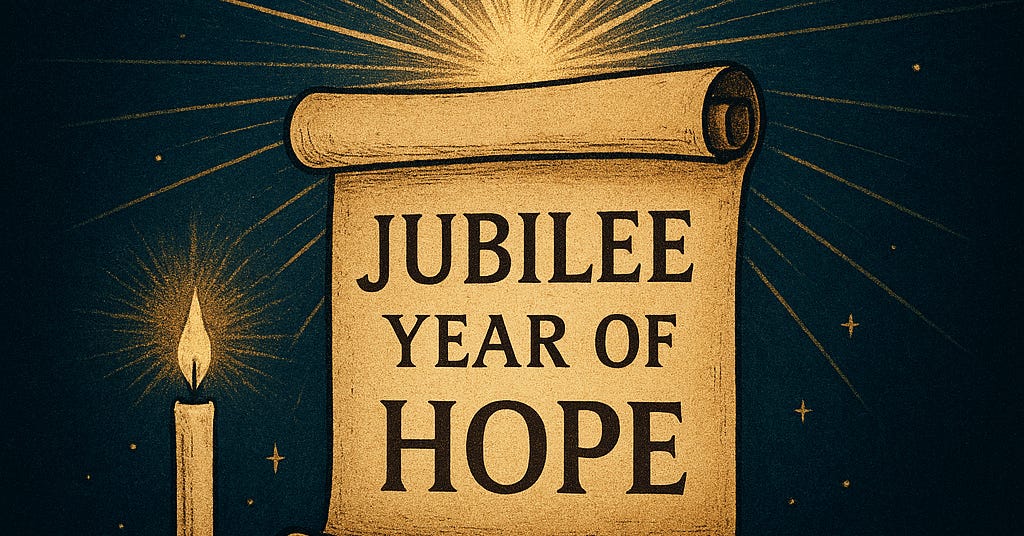
Imagine if God told you: “Everything gets a reset this year.”
Your freedom.
Your peace.
Your relationships.
Your hope.
This is exactly what the biblical Jubilee year was — and exactly what the Church is inviting you into right now. Its not too late. Although the year is coming to a close, the Jubilee Year of Hope is still alive and kicking. The Holy Spirit is still active in your life, Aslan is still on the move, right now. Rooted in Scripture, especially Leviticus 25, the Jubilee wasn’t symbolic or abstract. It was concrete: debts were forgiven, captives freed, land restored, rest commanded. A total reset of life under the loving lordship of God.
And for us today, in this Jubilee Year of Hope, that same invitation is alive:
to let God restore what has been lost, heal what has been wounded, and rekindle hope where it has grown dim.
Hope is one of the most essential virtues of the Christian life — and ironically, one of the hardest to hold onto. Especially now. We’re entering literally the darkest stretch of the year, the sun disappearing before many of us have even finished our workday. Advent always arrives in the shadows. And yet that is the season God chose to announce that light was coming into the world. To hold on.
Recently, I spent a weekend on a men’s retreat centered entirely on hope. What struck me most was how much we need hope precisely where things feel most hopeless: anxiety, broken relationships, trauma, depression, confusion, shame, or simply spiritual exhaustion. The Jubilee Year is an invitation to let God’s light reach the deepest darkness in your life.
Sooo dig deep, you still have time.
We can allow hope to come in deeper into our lives through the four marks of the biblical Jubilee — four rhythms the Church invites us to live spiritually this year.
1. Freedom From Captivity
In Scripture, the Jubilee year meant slaves were set free:
“You shall consecrate the fiftieth year, and proclaim liberty throughout the land to all its inhabitants.”
(Leviticus 25:10)
Spiritually, this means asking:
What has held me captive?
Maybe it’s:
- anxiety that storms your mind
- unforgiveness toward a family member
- shame that rewrites your identity
- a sin pattern that leaves you discouraged
- fear about your future
- a lack of trust in God’s goodness
On the retreat, I sensed God revealing how many of us carry invisible chains — old stories, old wounds, old burdens. The Jubilee Year of Hope is God saying: “You don’t have to stay here. Come out. I want you free.”
St. Paul echoes this beautifully:
“For freedom Christ has set us free.”
(Galatians 5:1)
Hope begins with stepping toward that freedom. Who do you need to forgive? What do you need to let go of? For what do you need to forgive yourself?
2. Release From Debts
The Jubilee year also meant that debts were forgiven. Imagine your student loans just wiped clean!
We may not owe literal money (or maybe we do), but our hearts carry emotional debts:
- grudges
- resentment
- expectations
- old hurts
- unspoken bitterness
As the saying goes:
“Holding a grudge is like drinking poison and expecting the other person to die.”
The Jubilee year is the chance to ask:
- What emotional debts are slowly poisoning your peace?
- How is un-forgiveness preventing me from growing closer to God and others?
Forgiveness does not erase the past —
it releases the power it has over the present. It also doesn’t even necessitate reconciliation, but is a letting go of hurts, pains, sufferings. A surrender.
And Scripture reassures us:
“As far as the east is from the west, so far does He remove our transgressions from us.”
(Psalm 103:12)
Maybe part of your Jubilee freedom is learning to forgive yourself.
3. Restoring God’s Kingship
In the Old Testament, Jubilee restored land to its rightful owner. Everything returned to its true order under God’s authority.
Spiritually, this asks us:
Where have I tried to be king of my own life?
Where have I held onto control out of fear?
Giving God kingship isn’t about losing power — it’s about regaining peace.
It’s remembering we are not spiritual orphans, abandoned to figure life out alone. We are children of a faithful Father.
As St. Augustine reminds us:
“Our hearts are restless until they rest in You.”
Hope grows where God is allowed to reign. So often our daily anxieties stem from trying to control with self-reliance instead of God-reliance. This control often stems from fear and believing things won’t be okay.
Restoring God’s Kingship involves declaring His authority, sovereignty, and all encompassing love in your life. That He has a plan of goodness for you.
4. Rest and Renewal (Sabbath)
Jubilee included rest for the land itself:
“The land shall keep a Sabbath to the Lord.”
(Leviticus 25:2)
This is more than “taking a day off.”
It’s a reminder that God does not love us for our productivity.
Sabbath is spiritual exhale.
It is the space where hope has room to breathe. Go ahead, take a breath right now! Practice that rest.
And Jesus Himself invites us here:
“Come to me, all who labor and are heavy laden, and I will give you rest.”
(Matthew 11:28)
The Jubilee Year calls us to reclaim that rest —
not as a luxury, but as a spiritual necessity.
Hope in the Darkness
This Jubilee Year of Hope meets us exactly where the world is physically and spiritually dim. But that is always where Christ begins His work.
Advent teaches us that light comes into the darkness —
not after it,
not instead of it,
but right in the middle of it.
Hope is not passive.
It is not simply “feeling optimistic.”
Hope is the decision to trust God in the dark before the dawn breaks.
St. John Paul II once wrote:
“We are the Easter people, and hallelujah is our song.”
Even when life feels like Good Friday.
You don’t need perfect faith to begin.
You only need enough trust to take one small step.
This is the year to reclaim hope.
Not because life is easy —
but because Christ is near.
Reflection Questions for Prayer + Journaling
- Where in my life do I feel “captive” right now?
What is God inviting me to walk out of? - What emotional or spiritual debts am I still carrying?
How have they been affecting my peace, relationships, or identity? - Where have I resisted letting God be King in my life?
What might one act of surrender look like this week? - How can I reclaim true Sabbath rest?
What small rhythms would allow hope to breathe again? - Where do I most need the light of Advent?
What is one dark place God is gently asking to enter? - What is one concrete act of hope I can practice today?
(e.g., confession, forgiveness, a small step forward, prayer, asking for help)
©️ 2017-2026 The Catholic Therapy Center, A Marriage and Family Therapy Professional Corporation | Site Credit | Privacy Policy | Good Faith Estimate