
Catholic Therapy Center

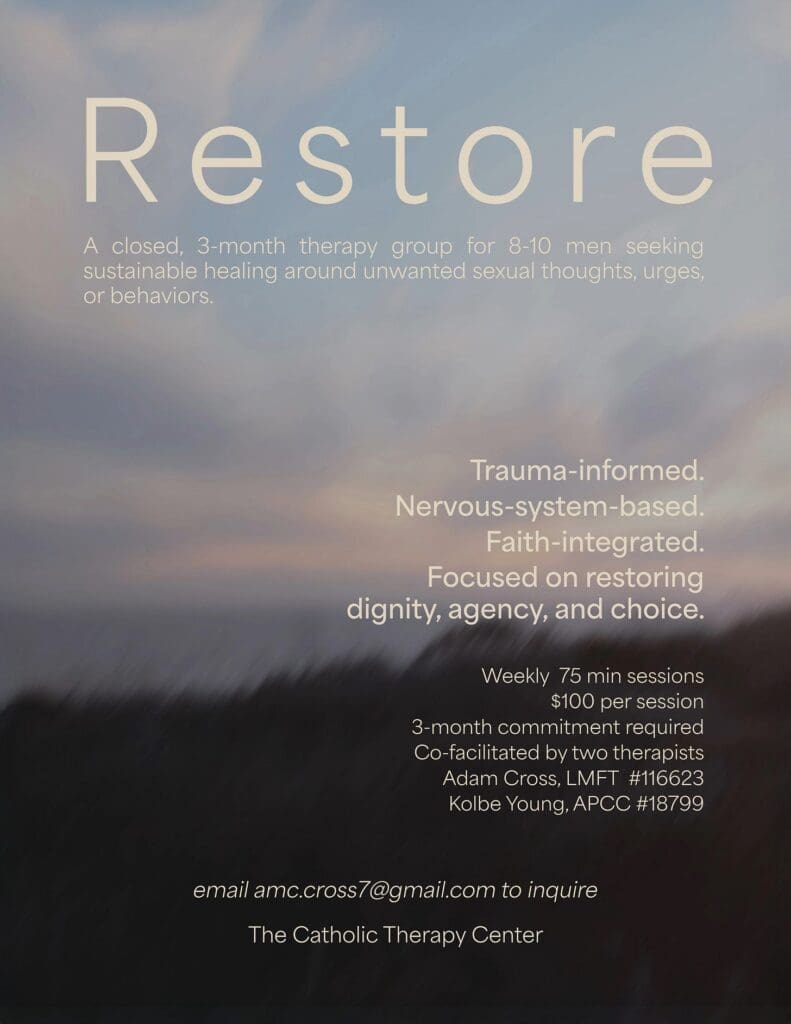
Introducing the Restore Therapy Group for Men
If you have been trying to change by praying harder, fighting harder, or making stronger resolutions, yet still find yourself returning to the same sexual patterns, you are not alone.
And this Lent, you may feel an invitation to try something different.
Because often, lasting change does not come from more effort alone, but from a new way of understanding what is happening beneath the behavior.
This does not mean trying harder or white knuckling your way through temptation.
For many men, the deeper invitation is not more pressure, but more honesty, more support, and a more integrated approach to healing, one that honors the body, the nervous system, the heart, and the soul.
As you prepare for Lent, consider sitting with these questions:
- What does healing actually look like for me?
- How might God be inviting me into freedom, not just restraint?
- What kind of support do I need to grow in a way that is sustainable and life giving?
The reality is: we live in a world where unwanted sexual thoughts, urges, and behaviors can feel overwhelming and unstoppable, often leading us into cycles of shame, secrecy, and isolation.
Introducing: the Restore Therapy Group
My colleague Kolbe Young and I are excited to announce the launch of Restore, a closed, small tele-health therapy group for men designed to help participants experience sustainable healing from unwanted sexual behaviors, including (but not limited to) pornography use.
This group will initially run for three months, and it’s designed specifically for men who:
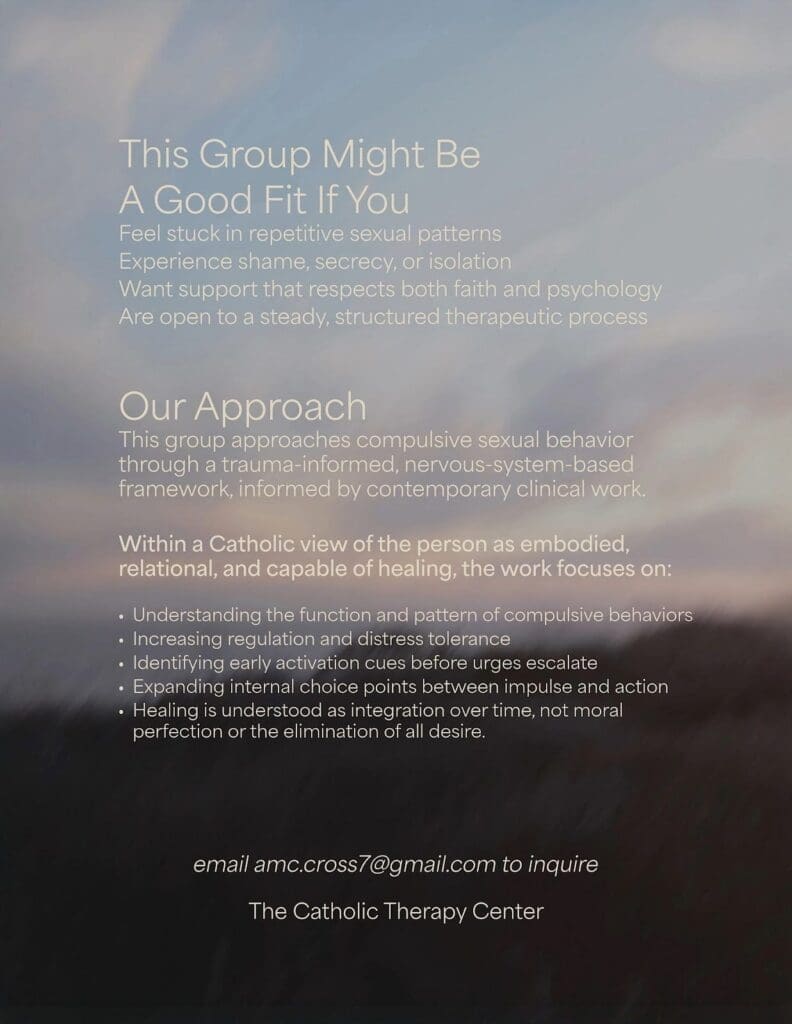
- feel trapped in repetitive sexual patterns
- experience deep shame and confusion
- feel isolated or alone in their struggle
- want accountability without condemnation
- want a recovery process that respects both clinical psychology and the Catholic faith
Because maybe you’re not just trying to “stop a behavior.”
You’re longing to become whole.
Why Restore?
Restore is more than a therapy group.
It’s a compassionate, non-judgmental space where men can explore the roots of their behavior through a trauma-informed, nervous-system-aware framework, while also grounding everything in the truth of the Catholic faith.
As Pope John Paul II beautifully expressed in Theology of the Body:
“The body, in fact, and it alone is capable of making visible what is invisible: the spiritual and the divine.”
In other words: your body is not a problem to escape or dominate.
Your body is not separate from you.
It is you.
Your body is an essential part of who you are, and often it carries important information about stress, longing, fear, and unmet needs. The body is, therefore, a mirror that reveals the glory of God to ourselves and those around us.
And because of original sin and lived experience, many of us develop a confusing relationship between desire and love, between longing and compulsion, between spirituality and the body.
Restore helps men honestly address:
- the spiritual aspects of temptation, compulsion, and addiction
- the psychological roots of compulsive behavior
- the nervous system patterns that drive self-medication
- the human need for love and connection that is often underneath it all
We believe healing begins by first meeting the struggle with dignity and understanding, so that meaningful change can actually take root.
What We Offer
Within the Restore group, participants will find:
1) A Trauma-Informed Framework
In Restore, we explore how unwanted sexual compulsions are often linked to stress, physiology, and the nervous system.
For many men, these behaviors aren’t just “bad habits” or moral weakness, they can function as ways to cope with:
- emotional overwhelm
- loneliness
- fear
- stress
- shame
- relational pain
- trauma wounds (past or recent)
The Catechism reminds us that sexuality is:
“an integral part of the love by which a man and woman commit themselves totally to one another” (CCC 2337).
That means that when sexuality becomes compulsive, isolating, or disconnected from love — it impacts far more than behavior. It affects identity, dignity, and the heart.
We integrate contemporary clinical research and tools around addiction and compulsive sexual behaviors, recognizing that many patterns serve as a form of self-medication, an attempt to regulate, soothe, and survive.
And in the spirit of many recovery models, we emphasize this truth:
understanding the pattern is the beginning of healing.
2) Faith and Compassion
Restore is grounded in a fundamentally Catholic worldview: you are not your sin.
You are a beloved son.
John Paul II wrote:
“Man cannot fully find himself except through a sincere gift of himself.”
This group helps men return to that deeper truth: healing is not merely about avoiding sin, but learning again how to live in freedom, how to love, and how to offer oneself in truth.
In Restore, you’ll learn how to practice a healthier, holier surrender to the Lord, not a shame-based surrender, but a real one.
A surrender rooted in trust:
- God is not disgusted with you
- God is not surprised by your struggle
- God is not waiting for you to “fix yourself” before He loves you
He is already moving toward you.
And healing often involves learning to receive that mercy at the root.
3) A Supportive Community
One of the most powerful elements of Restore is the brotherhood.
Men struggling with sexual compulsions often live in secrecy, and shame thrives in secrecy.
But something begins to shift when a man can finally say:
“This is what I’m struggling with.”
…and hear another man say:
“Me too.”
The Catechism teaches:
“In the light of faith, we see the body and sexuality as part of God’s good creation” (CCC 2331).
That means the goal is not to become less human, but to become fully human again.
We’ve consistently seen the impact of group process in sexual healing:
- story sharing breaks shame
- fellowship breaks isolation
- accountability breaks compulsivity
- honesty builds sober strength over time
Restore is not a place to perform holiness.
It is a place to practice healing.
The Journey Toward Healing
If you or someone you love is struggling with unwanted sexual urges, desires, and behaviors, consider inquiring to see if this group might be a good fit.
Healing is not about perfection.
Healing is not even about never falling again.
Healing is about integration over time, learning to live in greater freedom, and becoming increasingly capable of love.
As John Paul II noted:
“Real freedom is not the ability to do as we please, but the liberty to do as we ought.”
Healing involves picking up the tools God has given us spiritually, psychologically, and relationally, and with His grace learning to build a life of:
truth, beauty, and goodness.
This life will include imperfections.
But that is precisely where God meets us with mercy, and strengthens us to keep going.
And here’s the good news:
you never have to go it alone.
Come and See
We invite men who feel stuck in cycles of secrecy, shame, or isolation to join us.
Come and see.
Let this Lent be the beginning of something new.
This is a space to explore with compassion, reconnect with your faith, and move toward a life of deeper integration and healing.
If you’d like to inquire about participating in Restore, reach out to us directly for next steps and screening details.
Group Facilitators
Kolbe Young, Registered Associate Professional Clinical Counselor #18799
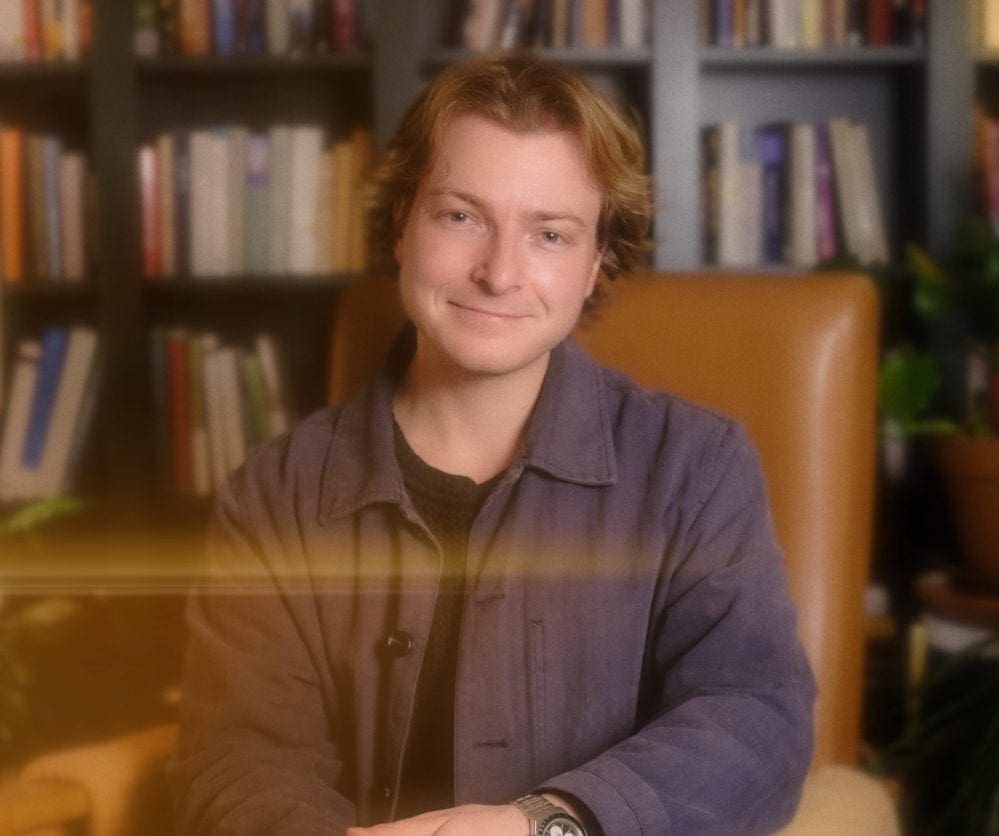
Hi, I’m Kolbe. I’m a husband, father, and integrative therapist with a deep commitment to embodied healing within the Catholic tradition.
Clinically, I work with individuals, couples, and families who feel stuck in patterns of anxiety, shame, trauma, grief, or disconnection. My work focuses on helping people gently turn toward what has been difficult to hold, so that healing can emerge through safety, presence, and integration rather than pressure or performance. My approach is warm, relational, process-oriented, IFS- and nervous-system-informed, and grounded in a Catholic understanding of the human person as an integrated unity of body, mind, and spirit. Alongside my clinical work, I facilitate workshops and write on Substack at the intersection of psychology, neuroscience, and Catholic spirituality.
I aim to create a space that is both clinically sound and spiritually respectful, where clients can slow down, listen inwardly, and develop greater resiliency and freedom in their lives.
I am currently accepting virtual clients throughout the State of California, as well as in-person clients in Westlake Village, CA, for individual, couples, family, and group counseling. Clinical supervision provided by Katelyn Smedley, LMFT #99805.
If you’re interested in exploring therapy together, collaborating on an offering, or learning more about my work, you’re welcome to reach me at (805) 253-2471 or at letsconnect@healingwithkolbe.com. You can also learn more at healingwithkolbe.com.
For those curious about developing greater capacity to slow down and process what keeps them stuck, I also offer a free and simple 5-Day program, Coming Home, which introduces body-centered practices for grounding, integration, and nervous system regulation.
Adam Cross, Licensed Marriage & Family Therapist #116623
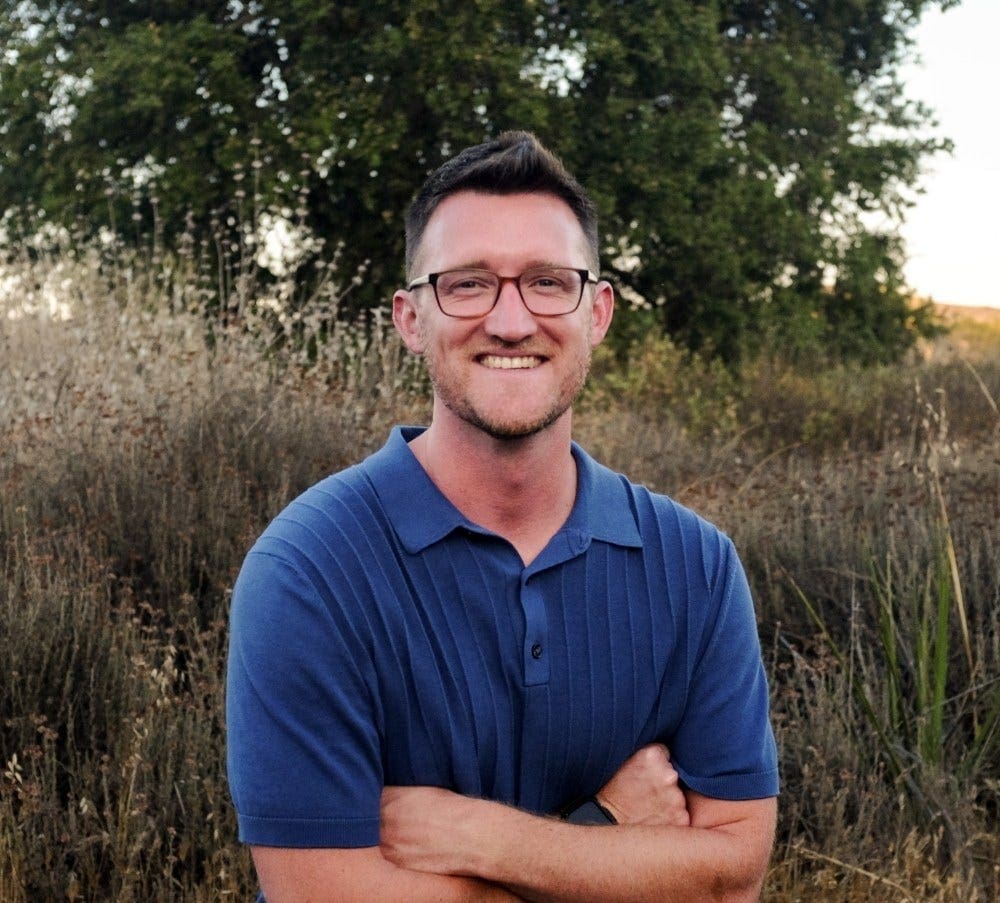
Adam Cross is a Licensed Marriage and Family Therapist (#116623), writer, and speaker who is passionate about helping people experience healing and freedom rooted in their identity as beloved sons and daughters of God. He is the founder of the Catholic Therapy Center — a group practice dedicated to a holistic Catholic approach to healing the human person through the power of the Holy Spirit.
Adam works with teens, young adults, and adults facing challenges like OCD, religious scrupulosity, anxiety, pornography addiction, trauma, and life transitions. His clinical approach integrates evidence-based practices like Exposure and Response Prevention Therapy (ERPT), Internal Family Systems (IFS), Cognitive Behavioral Therapy (CBT), attachment-based interventions, and healing prayer to help individuals experience both psychological and spiritual healing.
With a background in ministry as a former Youth Minister and Director of Ministry at his local parish, Adam brings both clinical skill and a pastoral heart to his work. He believes therapy is not just about symptom relief, but about accompanying each person in their journey toward wholeness in body, mind, and soul — helping them to encounter God’s love in the places of their greatest struggle.
Adam holds a Master’s degree in Clinical Psychology from Pepperdine University and a Masters in Theology from Franciscan University. He also has extensive experience working with individuals navigating depression, domestic violence, anger management, relationship difficulties, grief, faith struggles, and vocational discernment. He has a particular passion for supporting clergy, religious, and those in priestly formation.
Adam is committed to seeing and honoring the whole person — body, mind, and soul — and walking with them as they reclaim their dignity, freedom, and belovedness in Christ.
©️ 2017-2026 The Catholic Therapy Center, A Marriage and Family Therapy Professional Corporation | Site Credit | Privacy Policy | Good Faith Estimate